SnackPack Studios icon SnackPack StudiosKeeping Up with the Joneses
Free browser life sim · For older teens and adults

Keeping Up with the Joneses

You're doing fine. They're doing better. A turn-based satire about the cost of living, where every week hands you sixty hours and the rent is due either way.

Please note

This one is not for the kids

Most of what SnackPack Studios makes is calm, ad-free early learning for ages 3 to 12. Keeping Up with the Joneses is not. It is an economic satire written for older teens and adults, about debt, rent arrears, layoffs, gig work, speculative markets, burnout and status anxiety. There is nothing explicit in it, but the subject matter is adult and the humour is dry. If you arrived looking for a children's app, the SnackPack catalogue is over here.
Sixty hours is the whole game

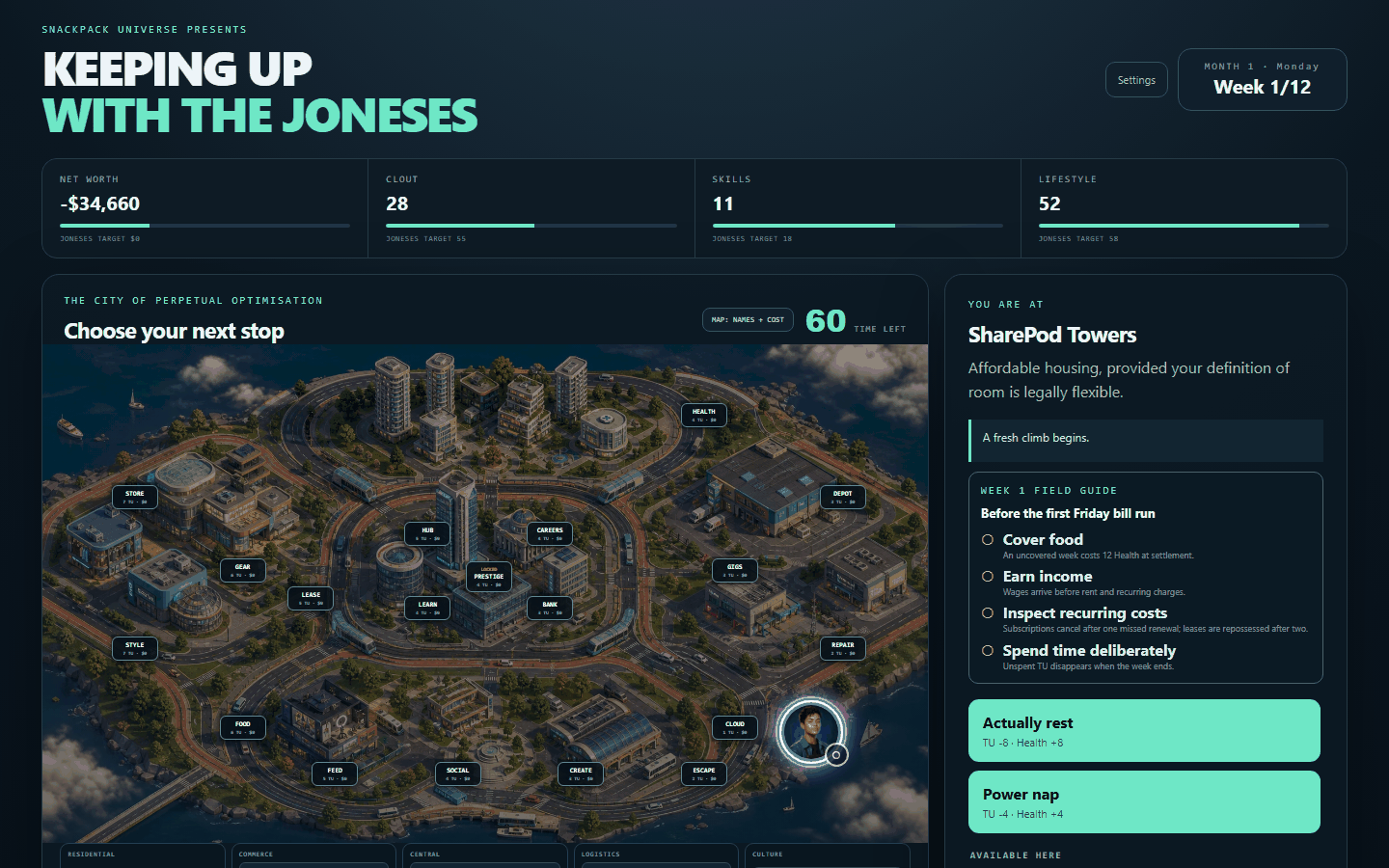
Money you can borrow. Time you cannot. Each turn is one week, and each week gives you sixty time units to spend across everything a life actually needs: shifts, commuting, studying, eating, sleeping, seeing people, and the occasional hour of doing nothing on purpose.

Every action prices itself in hours before it prices itself in money, so the interesting decisions are almost never about whether you can afford something. They are about what those hours were otherwise going to buy.

Four meters, four ways to fall short

  • Net Worth: what you own minus what you owe, and it starts negative.
  • Clout: social standing, which opens doors that money alone will not.
  • Skills: credentials that decay if you stop feeding them.
  • Lifestyle: the visible part, and the expensive part.

Each one carries a target set by the Joneses next door. Hitting three of four is a life most people would call successful. The game does not.

Real gameplay

A city where the address is part of the maths

Twenty locations across five districts, each with an opening cost in hours and money. Your job and your home are real places on that map, so a cheaper flat further out is a pay cut you volunteered for — and nine travel modes each trade money against time differently.

No account · No ads · No in-app purchases · Saves stay in your browser

Keeping Up with the Joneses showing the Week 1 city map, the four Life Plan meters and the sixty-hour time budget Week 1 board · Live game capture

Fourteen lives, each with a real advantage and a real bill

You choose who is trying to keep up. A service worker with spreadsheet credentials and thirty-eight thousand in education debt. A recovering high earner. A mobile gig worker with no fixed anything.

Each starts with a genuine edge and a genuine problem, and the Starting Position sheet itemises both before you commit — no hidden difficulty setting, just an honest balance sheet and an opening objective.

Nothing here is random for its own sake

The engine is deterministic. Every run has a seed, so the same seed replays the same twelve weeks exactly, and a run you enjoyed or a bug you hit can be handed to someone else as a number.

Thirty-six events fire across a run — a shift cancelled, a rent review, a certificate quietly expiring — and the settlement at the end of each week resolves them in a fixed, readable order.

A cost-of-living simulator, which is the honest description

Most life simulators are about accumulation. This one is about the arithmetic underneath it: rent that rises faster than wages, subscriptions that renew whether or not you used them, leases repossessed after two missed payments, skills that expire if you stop paying into them, and debt that compounds while you are busy at work.

It is a comedy. It is also, mechanically, a reasonably careful model of why keeping up costs more than it used to — and the Joneses are not a family you ever meet, just a line on your own scoreboard that keeps moving.

Help and answers

Keeping Up with the Joneses FAQ

Everything important about play, progress, privacy and what is coming next.

Is it free?

Yes. The browser game is free, ad-free and requires no account. There is no in-app purchase, no energy system and no paid unlock. A paid full release is planned for Steam; the browser version stays free when it arrives.

Who is it for?

Older teens and adults. It is an economic satire about debt, rent, layoffs, gig work and status anxiety. Nothing in it is explicit, but the subject matter is adult. It is not part of the SnackPack early-learning catalogue and is published separately from it.

How long is a game?

The browser version is a twelve-week run, roughly half an hour. Twenty-six-week and fifty-two-week games are planned for the full release.

Where is my progress saved?

In your own browser, with no account and no server-side save. Use Export to download a run as a JSON file and import it in another browser. Clearing site data for keepingup.snackpackuniverse.com removes the save and settings.

Does it work on a phone?

Yes. The layout adapts to narrow screens, and on desktop the game is fully keyboard accessible. It needs JavaScript and a browser released after 2022.

What do the four meters mean?

Net Worth, Clout, Skills and Lifestyle. Each carries a target set by the Joneses, the benchmark household next door. A convincing life needs all four, which is the joke and also the difficulty.

Why does where I live matter?

Jobs and homes have real addresses on the map, and travel costs time you cannot get back. Moving closer to work can be worth more than a pay rise — a calculation the game makes you do rather than tells you.

What is the run seed for?

The engine is deterministic, so a seed replays the same twelve weeks exactly. Share the number with a bug report and the run can be reproduced precisely, or use it to replay a game you liked.

Does the game track me?

Cloudflare Web Analytics measures aggregate page visits and performance. Gameplay events, character names, saves and free text are never uploaded. Full detail is in the game privacy policy.

How do I report a bug or send feedback?

Email support@snackpackuniverse.com. Include the run seed shown on the New Game screen and your browser, and the exact run can be replayed.